
-
ProductsThe company's products have been applied in 31 provinces, autonomous regions, and municipalities across China, serving 600,000 frontline law enforcement officers.
-
TechnologyBased on AI vision capabilities with multi-modal perception of speech, video, semantics, and bio-signs, the portable intelligent vision integrated system has reached an internationally advanced level.
-
SolutionFocus on providing customers with intelligent, secure, convenient, efficient, reliable and diversified services and industry solutions
-
-
BlogStrive to build a leading national brand of portable smart visual terminals
-
About UsFounded in 2008, it is a professional mobile audio and video law enforcement solution provider in the industry, and a high-tech enterprise integrating R&D, production, sales, and service.

Female vendor takes over the road and throws a tantrum, a small enforcement device clears the city management's name
Release Time:
2019-06-04
Recently, a video of urban management enforcement has gone viral online. In the video, urban management officers discovered a female vendor parking her food cart on a pedestrian crossing, obstructing traffic. Despite repeated warnings, the vendor refused to comply. The officers decided to impound the cart according to the law. However, during the process, the vendor tore at the officers' uniforms, poked them in the forehead, and even slapped one of them. The officers' body camera was also broken. The police arrived at the scene, took the vendor into custody, and gave her a 7-day administrative detention. The entire incident was recorded by the body camera, providing irrefutable evidence of the enforcement process. Nowadays, body cameras have become essential tools for law enforcement officers. With the continuous development of this technology, 4G body cameras are becoming increasingly prevalent. 4G body cameras are more intelligent and powerful than their predecessors. The new 4G platform enables remote control, one-button emergency calls, real-time image transmission, fast video transmission, dual-camera recording, and three-lens capabilities. This has led to flatter and more intelligent law enforcement. The smallest smart Android touch-screen device has Wi-Fi image transmission capabilities, GPS positioning, and smart charging, making the enforcement process similar to using a smartphone. The touch screen significantly improves efficiency in law enforcement and case handling. Body cameras protect both the enforcers and the enforced. Before the widespread use of body cameras in urban management, there was considerable public criticism. However, after their implementation, when police enforcement is appropriate, public opinion quickly subsides. In some cases, the lack of body cameras has put the police in a very passive position. If body cameras are standardized, the police will not face such difficulties when handling related cases.
Recently, a video of urban management enforcement has gone viral online. In the video, urban management officers, during enforcement, found a female vendor parking her food cart on a pedestrian crossing, engaging in illegal street vending. After repeated warnings, the female vendor refused to comply. The urban management officers decided to legally impound the food cart. Unexpectedly, during the enforcement process, the female vendor tore at the urban management officers' uniforms, poked them in the forehead, and even slapped one of them. The urban management officer's body camera was also broken. Subsequently, the police arrived at the scene, took the female vendor into custody, and imposed a 7-day administrative detention. All of this was body camera recorded, providing a true and accurate account of the enforcement scene, ensuring the process was documented.

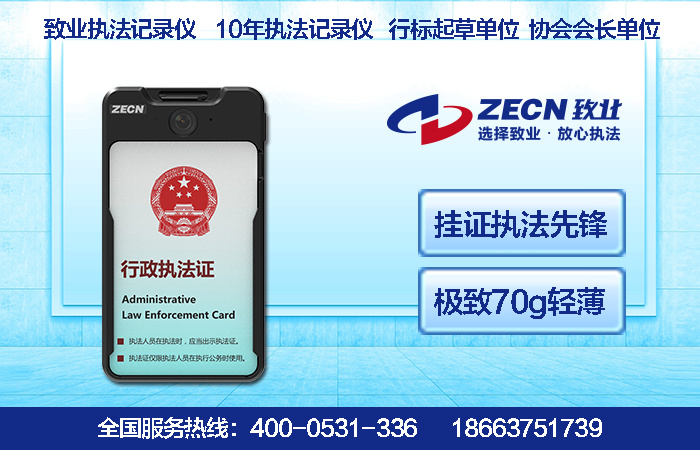
Now, Zhiye body cameras have become essential tools for law enforcement officers. With body camera continuous development, 4G body cameras are becoming increasingly prevalent, 4G body cameras building upon the foundation of body camera standard models, they are more intelligent and powerful. The new 4G platform enables remote control, one-button emergency calls, real-time image transmission, fast video transmission, dual-camera recording, and three-lens capabilities. This has achieved flat and intelligent law enforcement for law enforcement agencies: The smallest intelligent Android touch-screen device has Wi-Fi image transmission capabilities and can perform GPS positioning and intelligent charging. The law enforcement process is more similar to a smartphone, and touch control greatly improves law enforcement and case handling efficiency.

body camera This protects both the subject of enforcement and the enforcers. There are many examples where, before the use of body cameras in urban management, body camera public opinion was highly critical, body camera but after their use in the enforcement process, with proper police enforcement, public opinion immediately subsided. In some incidents, the police were very passive because they lacked body camera body cameras. If body camera body cameras were standardized, the police would not be so difficult in handling such cases.
Download
No attachments available for download at the moment
BLOGS

With the formal inclusion of full‑process recording in administrative law enforcement as a statutory requirement and the continued strengthening of workplace safety regulatory policies, 5G–AI body‑worn cameras and smart safety helmets—key visual‑perception terminals on the front lines—are rapidly gaining traction across sectors such as public security, urban management, market regulation, construction, power, mining, chemical industries, and emergency response. The industry is accelerating its transformation from “simple recording tools” to “intelligent sensing nodes,” with hardware capabilities, AI algorithms, and integrated platform solutions emerging as the core drivers of competitive advantage.

Don’t let trust be defeated by some vague, unclear detail.
A family member’s questioning triggered by a single nursing procedure, an unclear incident involving a child’s bump, conflicting accounts regarding a counter-service transaction, or the frustration of “no resolution after a home repair visit”... Misunderstandings and disputes in the service process often arise because details cannot be reconstructed and the sequence of events remains untraceable. Service staff find themselves unable to defend their actions, while service recipients harbor lingering doubts, leading to a gradual erosion of trust amid ambiguity.

Zhiye Smart Safety Helmet: Robust Protection, Intelligent Safeguarding
Morning light filters through layers of foliage as a little squirrel darts through the dense forest, conducting its rounds. Scaling hills and threading through thick woods, it must both identify potential hazards and confront the myriad unknown risks inherent in fieldwork. In vast, complex woodland areas, the ability to swiftly detect emerging dangers and promptly relay on‑site information is a major challenge for outdoor inspection operations. The Zhiye smart safety helmet, combining robust physical protection with all‑round intelligent safeguards, has become a dependable partner for safe inspections.

Today, service industries such as housekeeping, elderly care, childcare tutoring, and banking finance commonly face persistent challenges: opaque service processes, unclear delineation of rights and responsibilities, difficulties in post‑service traceability, and gaps in regulatory oversight—issues that can easily give rise to medical‑patient disputes, service‑related conflicts, and compliance risks. To address these industry‑wide pain points and comprehensively standardize offline service workflows while safeguarding the rights and interests of both providers and consumers, a multifunctional smart service recorder has emerged. With three core advantages—high‑definition recording, precise positioning, and ultra‑long battery life—it is designed to meet the diverse needs of multiple service sectors, ensuring that every interaction is thoroughly documented and fully traceable.

At the inspection site, inspector “Little Squirrel” was checking the operating status of equipment when he accidentally brushed against a junction box, causing the surrounding lights to go out instantly—a sudden power outage that plunged the entire work area into darkness. With no handheld flashlight and high-voltage equipment nearby, every second of obscured vision posed risks of missteps, collisions, or operator error. Just then, he raised his hand and lightly tapped the button on the front of his safety helmet, and a beam of bright light shot forth from the brim, steadily illuminating the path beneath his feet and the equipment panel before him. This isn’t a scene from a movie—it’s a real‑world scenario that can unfold during power‑grid maintenance, tunnel inspections, or nighttime construction‑site patrols. And that “light‑emitting safety helmet” is none other than the Zhiye Smart Safety Helmet.

Recently, the Shandong Provincial Department of Industry and Information Technology issued a public notice on the proposed list of the ninth batch of provincial industrial design centers and the list of those approved in the first seven batches. The public notice period has now concluded successfully. Across the province, a total of 146 enterprises have been proposed for designation as the ninth batch of provincial industrial design centers. ZECN’s “ZECN Industrial Design Center” was successfully selected and awarded the title of Shandong Provincial Industrial Design Center. This honor, conferred by the Shandong Provincial Department of Industry and Information Technology, represents an authoritative recognition from the provincial authorities of a company’s industrial design innovation capabilities, R&D system development, and market achievements, marking a new provincial-level milestone in the construction of ZECN’s industrial design innovation platform.
Want to learn more details? Welcome to call
General line:86-531-88910786
After-sales service:400-0531-336
Official website:www.chinaze.cn
Address:
7th floor, Qidi Zhixing, Zhongke New Economy Science and Technology Park, Qibu District, Jinan City, Shandong Province
Room 1616, Building 1, Aosheng Building, No. 1166, Xinluo Street, Gaoxin District, Jinan City, Shandong Province



Video Number

Tiktok